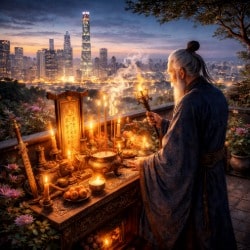
When people talk about Taoist magic altars, they often imagine a single thing: a table, some incense, maybe a talisman or two. Historically, that picture is far too small.
In Taoist tradition, an altar is not a generic surface for spiritual expression. It is a ritual instrument, engineered to support specific kinds of magical activity. Its layout, objects, orientation, and even permanence were shaped by time period, sect affiliation, and regional culture. A Taoist magic altar from the Han dynasty does not serve the same function as a Shangqing meditation altar or a southern Chinese household protection altar—and Taoist practitioners were keenly aware of those differences.
This article is a guide: a grounded, historically informed overview that connects the major altar types, their ritual purposes, and their evolution.
The Early Roots: Ritual Space Before Taoism Had a Name
Long before Taoism became an organized tradition, Chinese ritual specialists—often referred to collectively as wu—used temporary ritual spaces to negotiate with unseen forces. These early practices, dating back to the Shang dynasty and continuing through the Warring States period (c. 1600–221 BCE), involved spirit appeasement, illness removal, weather rites, and ancestral mediation.
There were no permanent altars in the modern sense. Instead, ritual space was constructed when needed and dismantled afterward. What mattered was not furniture, but alignment: direction, timing, correct objects, and the authority of the practitioner. This early logic is essential to understanding later Taoist magic altars. The altar was never the source of power—it was the framework that allowed power to operate coherently.
When Taoism later absorbed these practices, it inherited this foundational idea: space can be configured to influence reality, but only when done correctly.
Han Dynasty Taoism: When Altars Became Instruments of Order
During the Han dynasty (206 BCE–220 CE), Taoist thought became increasingly intertwined with imperial bureaucracy. Heaven was no longer imagined as a chaotic spirit realm; it was understood as a structured administration, complete with offices, ranks, and jurisdictions.
This shift profoundly changed altar design and function.
Altars became fixed ritual stations, often indoors, carefully oriented according to cosmology and direction. Talismans (fu) emerged as formal ritual documents—written commands or petitions addressed to specific celestial authorities. Incense functioned as a medium of transmission, carrying intent upward through invisible channels.
Magical activity at these altars was largely juridical in nature. Practitioners were not “casting spells” in the modern sense; they were filing ritual actions within a cosmic legal system. Illness, misfortune, and spirit disturbance were treated as administrative errors or violations of order that could be corrected through proper ritual procedure.
This bureaucratic worldview would shape all later Taoist magic altars, even as sects diverged in emphasis.
Medieval Taoism and the Differentiation of Altar Types
Between the fourth and sixth centuries CE, Taoism diversified into distinct ritual and contemplative traditions. This is the period when altar types truly differentiated, each supporting a specific category of magical activity.
Zhengyi Altars: Ritual Command and Intervention
Zhengyi (Orthodox Unity) Taoism, originating in the 2nd century CE and formalized in later centuries, is the tradition most strongly associated with active ritual magic.
Zhengyi altars were designed for direct intervention in the world. These were the altars used for exorcism, spirit negotiation, healing rituals rooted in spirit causation, and protective rites for homes, villages, and families. The objects placed on these altars—talismans, ritual swords, seals, registers—were tools of authority. Their presence signaled that the practitioner was acting under recognized cosmic mandate.
The magic performed here was neither symbolic nor abstract. It was practical, outcome-oriented, and often urgent. A Zhengyi altar functioned much like a command post: a place where disorder was identified and corrected.
Historically, these altars required lineage authorization. Without it, the tools themselves were considered inert.
Shangqing Altars: Internal Ascent and Subtle Magic
Shangqing (Highest Clarity) Taoism emerged in the 4th century CE with a very different emphasis. Rather than intervening in external affairs, Shangqing practice focused on internal transformation through visualization, meditation, and visionary ascent.
Shangqing altars were deliberately minimal. A lamp, incense, and sacred texts or diagrams were often sufficient. The altar did not perform the magic—the practitioner’s cultivated perception did. These altars supported magical activity such as spirit travel, divine communication, and internal purification.
Here, magic functioned as refinement rather than command. Changing the practitioner’s internal alignment was believed to reshape how they interacted with the world, producing effects indirectly rather than through overt ritual force.
Lingbao Altars: Cosmic Renewal and Collective Rites
Lingbao (Numinous Treasure) Taoism developed slightly later, synthesizing earlier Taoist ideas with broader cosmological concerns. Lingbao altars were designed for large-scale ritual work: salvation of ancestors, communal purification, and restoration of cosmic balance.
These altars were often elaborate, incorporating banners, charts of Heaven and Earth, multiple lamps, and extensive scriptural recitation. The magical activity performed here addressed not individuals, but systems—families, communities, even regions.
Lingbao magic is best understood as maintenance of the cosmos. Rather than correcting isolated problems, it sought to realign the larger pattern in which those problems arose.
Regional Expressions of Taoist Magic Altars
As Taoism spread, altar practice adapted to local culture without abandoning its core principles.
In southern China, especially Fujian and Guangdong, Taoist magic altars became dense and highly practical. Folk deities were integrated into Taoist cosmology, talismans were prominently displayed, and rituals focused on protection, illness, and spirit pacification. Magic here addressed immediate, lived concerns.
In northern China, altars tended to reflect imperial and scholarly influence. Layouts were symmetrical and hierarchical, emphasizing moral order and cosmological regulation rather than crisis intervention.
In Korea and Vietnam, Taoist altar practices blended seamlessly with ancestor veneration and indigenous spirit traditions. Altars were often domestic rather than institutional, supporting protective and relational magic tied to family continuity.
Across regions, the altar remained what it had always been: a localized expression of universal order.
Setting Up a Taoist Magic Altar Today
For modern practitioners without formal lineage, historical restraint is essential.
A responsible contemporary Taoist magic altar focuses on alignment, protection, and clarity, not coercive ritual action. A clean surface, incense burner, single lamp, and one symbolic focus—such as calligraphy or classical imagery—are historically appropriate and sufficient.
Talismans, ritual weapons, and seals should be approached with caution. In classical Taoism, these tools derive their function from transmission, not aesthetics.
An altar is not activated by accumulation. It becomes meaningful through consistency, respect, and maintenance.
Why Taoist Magic Altars Endure
Taoist magic altars survived because they worked within a coherent worldview. They did not promise control over reality, but cooperation with it. Across centuries, sects, and regions, one principle remains constant:
Alignment precedes effectiveness.
Magical Altars & Ritual Goods
Historically informed altar goods inspired by Taoist ritual practice—objects for protection, alignment, contemplation, and continuity. Designed for modern practitioners who value meaning, restraint, and tradition over spectacle.
Explore Altar GoodsFAQ
In Taoist practice, an altar is a structured ritual space used for alignment, offerings, protection work, and contemplative devotion. Historically, different altar styles supported different kinds of ritual activity (protective rites, healing rites, communal renewal rituals, or internal cultivation practices).
No. In context, “magic” refers to ritual methods—symbolic actions, offerings, texts, and tools used to support protection, clarity, and continuity. It’s closer to ritual tradition and religious practice than entertainment or fictional “spellcasting.”
The most common altar basics are an incense burner, a lamp or candle, a clean surface, and simple offerings like tea, water, or fruit. Some traditions also use devotional images, calligraphy, and ritual implements. Many advanced tools (such as ritual seals, swords, and formal talismans) are typically used under training and lineage transmission.
Broadly: some traditions emphasize practical protective rites and ritual authority, others emphasize internal cultivation and visualization, and others emphasize communal ceremonies and cosmic renewal. Each emphasis tends to shape the altar layout and the types of items used.
Yes. Local culture influences which deities are honored, what offerings are common, and how much the altar blends household devotion with formal ritual. The underlying pattern—clean space, offerings, incense, and symbolic alignment—tends to stay consistent even as the details shift.
Yes—keep it simple and respectful. Focus on cleanliness, a small lamp or candle, incense (if you use it), and modest offerings. It’s generally wise to avoid advanced or coercive ritual work without instruction.
They’re designed to support consistent practice—setting a clean ritual space, making offerings, and keeping a visible reminder of alignment and intention. Think of them as practical devotional objects rather than “guaranteed results.”
Related Articles
Small Taoist Shrines: Spaces of Harmony and Connection
Personal Altars in Taoism: From Ancient Traditions to Creating Your Own Sacred Space
Taoist Magic: History, Talismans, Rituals, and Modern Practice
The Origins of Taoist Magic: Early Classical Foundations
Taoist Talismans: History, Meaning, and Ritual Use Explained
You Are the Talisman: Understanding Daoist Talismans
Mystical Taoist Tapestries: Symbols of Power and Pathways to Spirit