What is intuition, and how have history’s greatest wisdom traditions understood it?
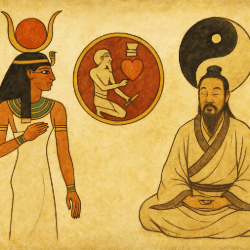
In this comparative deep dive, we explore how Ancient Egyptian spirituality, classical Taoism, and the 4 Ascendant Tradition of Taoism each frame intuition—not just as a psychological hunch, but as a profound spiritual faculty. Their perspectives offer powerful insight into how ancient civilizations cultivated inner knowing, divine awareness, and alignment with cosmic truth.
Understanding Intuition in Historical Context
In today’s world, intuition is often reduced to a “gut feeling” or subconscious pattern recognition. But for ancient spiritual systems, intuition was sacred—a bridge between the human and the divine, the visible and the hidden.
This article compares:
The Ancient Egyptian concept of intuitive knowing via the heart (ib) and Sia.
Classical Taoist insight through wu wei, pu, and the Tao.
The 4 Ascendant Tradition’s esoteric framework, which develops intuition as a pathway to transcending ordinary reality.
Note: The 4 Ascendant Tradition is approximately 1,500 years old and stands apart for preserving Taoist insight free from Confucian and Buddhist overlays. However, it has also continued evolving—allowing it to respond directly to modern challenges while retaining ancient methods.
Ancient Egypt: The Heart as the Seat of Intuition
In Egyptian thought, the heart (ib) was the core of wisdom, perception, and morality—not the brain. Intuition wasn’t seen as mysterious, but as the natural function of the heart aligned with Ma’at, the principle of cosmic truth and balance.
Key Concepts:
Ma’at: Truth, justice, harmony. One lives “in Ma’at” when acting in accord with universal order.
Sia: Personified insight or perception—intuition as divine awareness.
Akh: A transfigured, luminous spirit achieved through spiritual clarity and moral alignment.
🪶 Ritual, silence, and dream interpretation were means to access intuitive knowledge. The ib guided right action and discernment in both life and the afterlife.
Classical Taoism: The Flow of Intuition Through the Tao
Classical Taoism, as expressed in the Tao Te Ching and Zhuangzi, views intuition as spontaneous resonance with the Tao, the fundamental force behind all life. Logic is limited. True knowing comes through non-action (wu wei), stillness, and simplicity (pu).
Key Concepts:
Tao (道): The unnameable Way; natural order of the universe.
Wu Wei (無為): Effortless action aligned with the Tao.
Pu (樸): The uncarved block; pure, unconditioned perception.
Taoist sages cultivate a quiet mind and open spirit, letting insight arise naturally without force. This inner clarity reflects the true function of intuition—beyond words or structure.
The 4 Ascendant Tradition: Esoteric Training for Spiritual Intuition
The 4 Ascendant Tradition, a modern esoteric Taoist school, offers a layered model of perception. Intuition is not passive or random—it is deliberately cultivated through precise methods that clear blockages and restructure awareness. The goal is to develop Taoist Vision—the highest form of intuitive perception.
In this tradition, the function of intuition is to provide access to ling—the numinous, responsive spiritual power that lies behind all things. Ling is not merely an abstract force; it is a living, resonant field that responds to sincerity, presence, and cultivated perception. It is through this interaction that Ling causes transformation—altering perception, energy, and experience to bring one into deeper harmony with the Tao. Intuition becomes the gateway to spiritual efficacy, allowing one to sense and move in harmony with the unseen forces that shape reality.
Key Concepts:
Four Spheres: Social, Martial, Qi, and Tao. One must transcend each to refine perception.
Taoist Vision: Pure spiritual perception free of ego, language, and false constructs.
Ling (靈): The numinous or spiritual potency accessed through refined intuition.
Practice Structure: Includes meditation, energy cultivation, guided contemplation, and awareness training.
Unlike the spontaneous intuition of classical Taoism, this tradition sees intuition as a skill refined through practice and inner transformation.
Practices: Inner dissolving, awareness flow training, and long-term meditative protocols designed to “burn off” the conditioning of the Social Mind.
| Element | Ancient Egypt | Classical Taoism | 4 Ascendant Tradition |
|---|---|---|---|
| Core Principle | Ma’at (truth/harmony) | Tao (the Way) | Tao (perceived through Taoist Vision) |
| Seat of Intuition | Ib (Heart) | Empty Mind / Pu (Simplicity) | Trained Taoist Vision |
| Expression of Insight | Sia (divine perception) | Wu Wei (effortless knowing) | Transcending Spheres |
| Practices | Ritual, dream interpretation | Meditation, nature immersion | Energy, vision, and structural awareness |
| Goal | Become an Akh (radiant being) | Union with the Tao | Direct perception of Tao |
Shared Themes Across Traditions
Despite cultural and temporal distances, all three traditions suggest the same truth:
Intuition is spiritual—a means of perceiving the divine or the real.
Stillness, detachment, and inner purity are necessary.
Each system treats perception as morally and cosmically significant.
Intuition is accessible, but must be cultivated.
Their language differs, but the message aligns: The path to true knowing begins by letting go.
Why This Matters Today
We live in an era of overwhelming mental noise and information overload. Ancient traditions remind us that truth isn’t always found by thinking harder—it’s found by listening more deeply. These cultures didn’t just honor intuition—they taught how to access it systematically.
If you want to reconnect with intuitive clarity, these traditions offer powerful starting points:
Embrace inner silence (Egyptian).
Let go of control (Classical Taoism).
Train perception through disciplined practice (4 Ascendant).
Modern intuition has ancient roots. And we’re only just beginning to remember.
Frequently Asked Questions
In Ancient Egypt, intuition was centered in the heart (ib) and tied directly to moral judgment and harmony with Ma’at. In Taoism, intuition arises from inner stillness and natural spontaneity, allowing a person to act in alignment with the Tao without conscious effort.
Intuition in the 4 Ascendant Tradition is refined through a structured path of transcending the Four Spheres—social conditioning, physical instinct, energetic sensitivity, and finally, spiritual clarity. The aim is to awaken Taoist Vision and gain access to Ling, the transformative spiritual potency.
No. Qi is the life-force energy that flows through the body and the world, while Ling is a higher-order spiritual responsiveness. Qi can be cultivated for vitality and health, but Ling represents the numinous intelligence of the cosmos and is accessed through intuitive resonance.
These traditions view intuition as a form of direct knowing that transcends rational limitations. Logic, while useful, is often seen as bounded by language and ego. Intuition offers access to deeper truths that align the individual with universal forces.
Yes. All three traditions suggest that intuition is not a fixed trait, but a faculty that can be nurtured. Ritual, meditation, energy work, and ethical clarity are some of the tools used to deepen intuitive perception.