Rain is the breath of the world.
When it does not come, the world holds its breath with it. In the villages of old China, the fields turned silver and gray beneath the unbroken sun, and the people looked upward in silence until someone whispered the ancient question: Has Heaven forgotten us?
That was the moment the priest would be called.
The Origins of Qiuyu
The word qiuyu (祈雨) simply means “to pray for rain,” yet within the Taoist tradition it carries a gravity closer to negotiation. Rain was never only weather; it was a sign of balance between Heaven, Earth, and the human heart. The earliest Chinese rulers kept ritual calendars for petitioning the sky, and the Zhou chronicles record offerings to the Dragon Kings—spirit lords of water who governed clouds, rivers, and storms.
By the Han dynasty, these rites had deepened into a moral contract. When drought came, the emperor or local magistrate was expected to fast, release prisoners, and confess his failings before Heaven. If the skies remained silent, Taoist ritualists were summoned. The priest stood at the threshold between cosmos and community, his role not unlike that of a physician: to diagnose the imbalance and prescribe harmony.
The Structure of the Rite
A Taoist rainmaking ceremony followed the rhythm of purification.
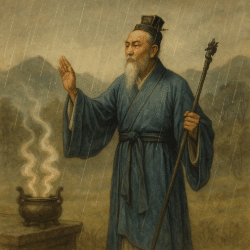
The priest would abstain from meat and grain, burn incense of cypress and sandalwood, and set up an altar facing the east—the direction of wind and renewal. Talismans inked in vermilion invoked the Azure Dragon of the eastern sea. The priest intoned scripture from the Book of Supreme Peace or the Lingbao canon, calling upon the Celestial Ministers of Moisture and the Lords of Cloud and Thunder.
During the zhaijiao fast, assistants maintained silence and carried bowls of pure water to symbolize the desired return of rain. Drums beat in slow, even measures to mirror the rhythm of thunder. In some accounts, the priest drew a dragon in the air with a sword of peachwood, its invisible coils meant to summon the clouds.
The ritual could last a day or stretch into three, depending on the stubbornness of the drought. When at last the wind rose or a gray halo formed around the sun, the people exhaled in collective relief—the world breathing again.
The Role of the Taoist Specialist
Rainmaking was rarely spontaneous devotion. Communities, temple associations, and even provincial officials commissioned these rites. The Taoist priesthood, unlike the cloistered monastics of other faiths, existed as a public service: itinerant, trained, and responsive to civic need.
Payment—whether in coin, rice, or offerings—was customary, not profane. In the Taoist view, energy must circulate; to perform sacred work without exchange would arrest the balance it seeks to restore.
The service carried social weight. A successful qiuyu elevated the status of the officiant and the temple; a failed one risked ridicule or even punishment if the drought persisted. Some priests specialized in weather rites, traveling between prefectures much like physicians, their reputations following the rain.
Between Ritual and Governance
Official history shows a curious duality: Taoist priests and government magistrates often cooperated in drought relief, yet they also competed for Heaven’s attention. In Tang and Song times, if the emperor’s edict to pray for rain went unanswered, it was interpreted as a sign of moral lapse within the court. The state thus relied on religious specialists to mend cosmic legitimacy.
In the countryside, local leaders sometimes hired Taoist or Buddhist clerics independently, demonstrating how ritual economy threaded through daily governance. The rainmaking priest, therefore, was both mystic and civil servant—his altar a weather bureau of the soul.
The Moral Weight of Water
Taoism regards water as the model of virtue. It seeks the low place, benefits all things, and contends with none. Yet when Heaven withholds it, humans must examine their own conduct. Drought was seen not simply as a meteorological accident but as a reflection of imbalance in collective qi. The rain ceremony thus became a moral mirror: the community confessed, fasted, and re-aligned itself with the Way.
The priest’s chants—calling dragons, burning talismans—were outer forms of an inner work: restoring humility. Rain arrived when the people remembered their smallness before the vast design.
Beyond China: The Mongolian and Inner Asian Echo
Across the northern plains, Mongolian shamans practiced weather magic of their own. Their blue-sky rituals, preserved in oral chants, asked the tenger—the Sky Fathers—to release rain upon the steppe. In the 17th century, under Qing influence, some of these rites absorbed Buddhist and Taoist elements: the invocation of the Dragon Kings, the use of incense and ritual banners, even formal petition scripts resembling Chinese liturgy.
Among nomadic groups, ritual specialists were likewise called in by communities or khans to intercede with Heaven. Ethnographic accounts describe the shaman being invited to the camp, offered gifts of dairy or cloth, and seated before the fire to chant the weather songs. The practice paralleled the Chinese system of commissioned ritual, though its cosmology spoke of ancestral spirits rather than celestial bureaucrats.
This blending of traditions—Mongolian, Tibetan, Taoist—formed a weather bridge across Inner Asia. Where fields ended and grasslands began, the same longing for balance joined hands across cultures.
The Art of Failure
Not every rain rite succeeded. Some records tell of priests dismissed in disgrace or temples abandoned after repeated droughts. Others note that rain came days later, “when the sincerity of the people was complete.” Taoist scripture counseled patience: Heaven’s timing followed cycles deeper than petition.
Failure was part of the art. To ask for rain was to acknowledge dependence on what cannot be commanded. In that humility lay the true purpose of qiuyu: not mastery over the elements, but remembrance of one’s place within them.
The Quiet Legacy
Today, rainmaking survives less as ceremony than as metaphor. Modern Taoist temples may still perform weather prayers during extreme drought, yet most understand the ritual symbolically—an act of ecological mindfulness, a call for harmony between human industry and the living sky.
To stand beneath the first drops after such a rite is to feel something older than religion: gratitude shaped by awe. The priest’s words dissolve into the rhythm of water striking earth, and for a brief moment, Heaven and Humanity breathe together again.
References & Further Reading
Coercing the Rain Deities in Ancient China — Journal of Chinese Religions, 2003.
“Taoist Rain-Praying Techniques (道教祈雨)” — Longhu Mountain Cultural Foundation.
Kim, K. H. “Rainmakers for the Cosmopolitan Empire: Weather Magic in Late Imperial China and Inner Asia.” Religions 11(12), 2020.
The Tibetan Weather Magic Ritual of a Mongolian Shaman — ethnographic paper, Academia.edu.
Selections from Lingbao Jing and Taiping Jing for classical liturgical formulas.
Bring the teachings into your space.
Explore Taoist altar goods — candles, offering cups, and wall art designed for living practice, not display.
Frequently Asked Questions
What is Qiuyu in Taoist tradition?
Qiuyu (祈雨) means “to pray for rain.” It refers to Taoist ritual ceremonies performed to restore harmony between Heaven and Earth during times of drought. Priests would fast, purify themselves, and use talismans, incense, and chants to call upon celestial forces such as the Dragon Kings and Lords of Rain.
Why did Taoist priests perform rainmaking rituals?
Taoist cosmology teaches that drought represents imbalance within the natural order. When rain failed, priests were asked to intercede to correct that imbalance. Their role was to realign human conduct and spiritual energy with the flow of the Tao so that Heaven would once again release water to the earth.
Were Taoist priests hired to perform these rituals?
Yes. Taoist priests commonly served as ritual specialists commissioned by local leaders, communities, or imperial officials. Payment in offerings or coin was considered part of the sacred exchange of energy—sustaining the priesthood and honoring the effort of spiritual service.
What did a typical rainmaking ceremony involve?
The priest purified the space, set up an altar facing the east, and used ritual implements such as a peachwood sword and a bronze censer. Incantations invoked water deities, while assistants maintained silence and rhythmic drumming to mirror the sound of thunder. The ritual could last several days depending on local conditions.
Did other cultures practice similar forms of rainmaking?
Yes. In Mongolia and other parts of Inner Asia, shamans and Buddhist lamas performed weather rituals that shared symbols with Taoist practices—such as invoking sky spirits and dragon deities. These cross-cultural exchanges reflect how communities throughout Asia sought harmony with nature through sacred ceremony.
Is rainmaking still practiced today?
Modern Taoist temples occasionally perform symbolic weather prayers during extreme droughts. While most people now see these rites as metaphors for ecological harmony, they continue to express the timeless Taoist principle that humans and nature breathe together as one body.