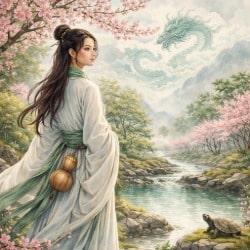
Renewal, Wood Energy, and the Rising Breath of Life
When winter loosens its grip and the soil begins to breathe again, the Taoist world turns toward spring.
In Taoist thought, the seasons are not merely weather patterns or markers of time. They are phases in a larger cycle of transformation. Each season expresses a movement of qi, the vital energy that flows through nature and the human body alike.
Spring is the moment of emergence.
Seeds break open beneath the earth. Sap rises in trees. Rivers swell with melted snow. What was hidden begins to show itself.
The ancient Taoists watched these patterns closely. They believed that to live well, a person should move in harmony with them.
Spring is therefore not simply a time of new beginnings. It is the season of growth, direction, and awakening life.
To understand Taoism and spring, we must look at the cosmology that connects nature, the body, and the unfolding rhythm of the Tao.
The Place of Spring in Taoist Cosmology
In traditional Chinese thought, the year unfolds through the Five Phases (Wu Xing):
Wood
Fire
Earth
Metal
Water
Each phase represents a pattern of transformation.
Spring belongs to Wood.
Wood does not mean lumber or timber alone. It represents the energy of growth, expansion, and upward movement. It is the force that pushes a sprout through soil or stretches a branch toward sunlight.
Ancient Taoist texts often describe spring energy as rising qi.
Winter energy moves inward and downward. Spring reverses this movement. Life begins to push outward again.
This transformation appears everywhere:
buds forming on trees
animals leaving winter dens
streams running stronger
fields turning green
In Taoist observation, these changes reveal the Tao at work in the world.
The Tao is not abstract philosophy. It is visible in the way things grow.
Spring and the Liver System in Taoist Medicine
Taoist seasonal philosophy became deeply integrated into traditional Chinese medicine (TCM).
Each season corresponds to an organ system.
Spring is linked with the liver.
In Western medicine, the liver is primarily associated with detoxification and metabolism. In Taoist medical thought, its function is broader. The liver governs the smooth flow of qi throughout the body.
This is an important idea.
Just as sap must flow freely through a tree for it to grow, qi must move freely in the human body for health to be maintained.
When liver qi flows smoothly:
the body feels energized
emotions remain balanced
the eyes are clear
movement is fluid
When the flow becomes blocked, symptoms may appear:
irritability
headaches
digestive tension
fatigue
Spring practices in Taoist medicine therefore emphasize movement, stretching, and gentle detoxification. The goal is to support the body’s rising energy rather than resist it.
The Direction and Color of Spring
In classical Taoist cosmology, every season also corresponds to symbolic elements of the natural world.
Spring is associated with:
Direction: East
Color: Green
Planet: Jupiter
Element: Wood
The East is where the sun rises.
It represents beginnings.
Many ancient Chinese cities and temples incorporated this symbolism into their design. Gates facing east were often associated with renewal, growth, and favorable beginnings.
Green, the color of young plants, became the visual marker of this season’s energy.
These correspondences were not considered mystical decoration. They were ways of mapping the movement of qi across the world.
The Spring Season in the Tao Te Ching
The Tao Te Ching, attributed to Laozi, rarely speaks about seasons directly. Yet its imagery often reflects the logic of seasonal change.
Several passages describe the quiet power of growth.
One famous line states:
“The Tao produces all things.
It nourishes them and does not claim them.”
Spring illustrates this principle clearly.
Plants grow without command. Flowers open without instruction. The Tao nourishes life but does not force it.
This is an example of wu wei, often translated as “effortless action.”
Spring growth appears effortless. Yet the energy behind it is immense.
The Taoist sage observes this and learns from it.
Growth does not require strain. It requires alignment.
Spring in the I Ching
The I Ching (Book of Changes) provides another lens through which Taoists viewed seasonal transformation.
Several hexagrams correspond symbolically to spring.
One of the most important is Hexagram 3 – Difficulty at the Beginning.
This hexagram represents the moment when something new struggles to emerge. The image is that of a sprout pushing through the earth.
The message is simple but profound.
Beginnings are rarely smooth.
The energy of spring is powerful, but it is also chaotic. Life is reorganizing itself after the stillness of winter.
Another hexagram linked to spring is Hexagram 42 – Increase.
Here the imagery suggests growth and expansion. The time favors development, generosity, and forward movement.
In Taoist seasonal interpretation, these hexagrams reflect the creative turbulence of early life.
Spring is not calm. It is fertile.
Historical Taoist Practices in Spring
Different Taoist communities expressed the spring season in various ways.
Some practices were simple.
Farmers aligned planting schedules with lunar cycles and seasonal qi. Temple communities held rituals celebrating renewal and harmony with nature.
Others practices were more structured.
In sectarian Taoism, particularly during the Tang and Song dynasties, spring festivals often included:
purification rituals
incense offerings
renewal ceremonies
communal prayers for agricultural success
These events recognized that the well-being of the community depended on the balance of nature.
In southern China, where spring arrives earlier, these ceremonies often began in late winter. In northern regions they occurred closer to the vernal equinox.
Geography shaped practice, but the underlying philosophy remained the same.
Spring was a moment to realign with the Tao.
The Festival Calendar of Spring
Several traditional Chinese festivals fall within the Taoist understanding of spring.
One of the most important is the Qingming Festival, often translated as Pure Brightness Day.
This festival occurs in early April and combines several themes:
honoring ancestors
visiting graves
celebrating the renewal of life
Families clean ancestral tombs and make offerings, acknowledging that the past continues to nourish the present.
Another important celebration is the Shangsi Festival, historically associated with purification and renewal rituals performed near rivers.
Participants would wash themselves or symbolic objects in flowing water, representing the cleansing of stagnant qi accumulated during winter.
In Taoist thought, such acts were not merely symbolic.
They were practical methods for restoring harmony between human life and seasonal change.
Spring and the Discipline of Qi Gong
Taoist cultivation practices also adapt to seasonal cycles.
Qi Gong, the art of working with internal energy, often changes its emphasis during spring.
Winter practices typically emphasize stillness and conservation.
Spring practices encourage gentle expansion and circulation.
Common movements during this season include:
stretching exercises
twisting motions that stimulate the liver meridian
breathing techniques that expand the chest and diaphragm
These movements mirror the rising energy of nature.
Just as plants stretch toward sunlight, the body is encouraged to open and move.
Practitioners are often advised to train outdoors during spring when possible.
Fresh air and natural surroundings amplify the body’s connection to seasonal qi.
Spring in Taoist Gardens
Taoist gardens were designed to mirror the natural world.
They are not arranged according to strict geometric order. Instead they create landscapes that evoke mountains, rivers, and forests in miniature.
Spring plays a special role in these spaces.
Garden designers often selected plants that bloom sequentially throughout the season:
plum blossoms in late winter
peach blossoms in early spring
magnolia and pear blossoms soon after
Each bloom marks a stage in the unfolding of life.
Walking through such a garden becomes a meditation on time itself.
In Taoist philosophy, observing these cycles helps cultivate inner stillness and awareness of change.
The garden becomes a teacher.
The Queen Mother Collection
Inspired by Xiwangmu and the Peach of Immortality—shop art, mugs, totes, and altar-ready pieces.
Explore the CollectionEmotional Energy of Spring
The rising energy of spring affects the mind as well as the body.
In Taoist psychology, the liver system also influences emotion and intention.
When balanced, spring energy supports:
creativity
planning
vision for the future
When unbalanced, the same energy may produce:
impatience
anger
frustration
This dual nature reflects the power of growth itself.
A plant that grows too quickly may become fragile. A person who pushes too hard in spring may exhaust their energy before summer arrives.
Taoist wisdom therefore recommends moderation.
Growth should be encouraged but not forced.
Living in Harmony with the Spring Season
Classical Taoist texts often advised adjusting daily life to match seasonal rhythms.
During spring this includes several practical principles:
Wake earlier.
The rising sun reflects the season’s energy.
Move the body.
Stretching and walking help circulate qi.
Eat fresh foods.
Young greens and light meals support the liver system.
Spend time outdoors.
Exposure to wind, sunlight, and living landscapes reconnects the body to nature’s rhythm.
These habits may sound simple, yet they express a profound idea.
Health emerges when human life moves with the patterns of the world.
Spring as a Metaphor in Taoism
Beyond physical health and seasonal practice, spring also serves as a metaphor in Taoist philosophy.
It represents the moment when potential becomes action.
A person who has studied quietly for years may suddenly step forward and begin teaching.
A community may grow after long preparation.
A new idea may take root in the mind.
These moments resemble the first shoots of spring plants.
They begin quietly, almost invisibly.
Yet once the process starts, growth becomes unstoppable.
The Deeper Lesson of Spring
Taoism often emphasizes returning to the natural world as a source of wisdom.
Spring teaches one of its most important lessons.
Life renews itself.
Even after the cold stillness of winter, growth returns.
Seeds survive beneath frozen soil. Trees that appeared lifeless begin to bud again.
For the Taoist observer, this cycle reflects the deeper nature of the Tao itself.
The Tao does not cling to endings.
It continually generates beginnings.
Conclusion
Spring in Taoism is more than a season.
It is a phase in the great movement of life.
Through the lens of the Five Phases, the teachings of the Tao Te Ching, the symbolism of the I Ching, and the practices of Taoist medicine and cultivation, spring reveals the Tao’s creative energy in action.
The ancient sages did not treat these ideas as poetic metaphors alone.
They saw them unfolding daily in the world around them.
The rising sap of trees.
The return of birds.
The greening of hillsides.
Each sign pointed to the same truth.
Life moves in cycles.
And when we learn to move with those cycles, we discover something remarkable.
We begin to live in harmony with the Tao itself.
Taoism and the Spring Season – Frequently Asked Questions
What does spring represent in Taoism?
In Taoist philosophy, spring represents renewal, growth, and the rising movement of qi. It is the season when life begins to emerge after winter’s stillness. Plants grow, animals become active, and energy moves outward in nature and within the human body.
What element is associated with spring in Taoism?
Spring corresponds to the Wood element in the Five Phases system (Wu Xing). Wood represents expansion, upward movement, and development. It reflects the way plants grow toward sunlight and how energy begins to rise again after winter.
Which organ system is linked to spring in Taoist medicine?
Traditional Chinese medicine associates spring with the liver system. The liver governs the smooth flow of qi throughout the body. When this energy moves freely, a person experiences balanced emotions, clear vision, and physical vitality.
What animal represents spring in Chinese cosmology?
The traditional guardian of spring is the Azure Dragon (Qinglong). It represents the eastern direction, the Wood element, and the rising life force of the season. In ancient astronomy and mythology, the appearance of the Azure Dragon constellation signaled the beginning of the agricultural season.
How do Taoist practices change during spring?
During spring, Taoist practices emphasize gentle movement and expansion. Qi Gong exercises often include stretching, twisting, and breathing techniques that help circulate rising qi. Spending time outdoors and moving the body supports the natural energy of the season.
Why is spring important in Taoist philosophy?
Spring demonstrates the Taoist principle of natural transformation. After winter’s inward stillness, life begins to grow again without force or struggle. Taoists observe this process as an example of wu wei, or effortless action, where growth happens naturally when conditions are right.
Further Articles Exploring Taoism and Nature
Taoist Relationship to Nature: Harmony, Simplicity, and the Way of All Things
Trees in Taoism: Sacred Roots, Symbolism, and Practice Across Time and Tradition
Animals in Taoism: Companions, Teachers, and the Tao
Gathering the Elixir: Taoist Alchemy and the Season of Autumn
Winter in Taoism: The Deep Season of Return
Taoism and Weather: History, Rituals, and Meaning Across Cultures
Taoist Gardens: Sacred Spaces of Nature, Stillness, and the Dao
Peaches of Immortality: Taoism’s Symbol of Longevity and Spiritual Transformation