Introduction
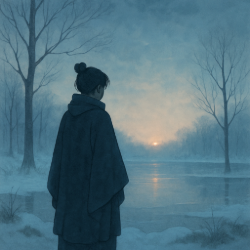
Winter approaches without urgency. It shortens the arc of sunlight, cools the edges of the earth, and mutes the sound of the human world until breath becomes its own small lantern. To the Taoist imagination, this is not simply a shift in temperature. It is the season in which the world reveals one of the Tao’s quiet instructions:
When Yang withdraws, Yin completes its arc. When life turns inward, wisdom begins.
Winter is the deep season—a time when nature gathers its strength by appearing to release it. What looks like stillness is a form of preparation; what looks like emptiness is a kind of fullness turned inward. This tension between seeming and essence is one of the most ancient themes of Taoist thought, appearing in the Daodejing, the Zhuangzi, the early medical texts, and later in the ritual and meditative traditions of sectarian Taoism.
Winter, perhaps more than any other season, shows us what the Tao means by returning to the root.
The Character of Winter: Yin Reaching Its Completion
When classical Taoist writers describe the movement of the seasons, they rarely speak of weather. Instead, they speak of qualities—the inward curl of leaves, the descent of water into deep channels, the slowing of animal movement. These are not random behaviors; they are expressions of Yin, the receptive and accumulating force.
In winter, Yin is not growing—it is full. It has completed the long descent that began in late summer and has reached the point where quiet becomes its most eloquent form.
The Huangdi Neijing, China’s foundational medical classic, instructs:
“In winter, hide your intention as though you hold a secret.
Let the breath settle, and the spirit remain still.”
To conserve energy during winter is not merely healthy; it is cosmologically appropriate. The Kidney system—associated with Water, wisdom, and the deepest reserves of vitality—governs this season. Overexertion in winter has always been considered a kind of theft from spring.
For readers familiar with the I Ching, winter carries the quiet gravity of Hexagram 2 (Kūn — The Receptive). Earth rests, not in abandonment, but in readiness. Its strength is not in force but in its capacity to hold, receive, and keep. Winter teaches the same lesson: that the deepest form of resilience often looks like stillness.
Water and Depth: The Taoist Element of Winter
Water governs winter in the Five Phase (Wu Xing) system. This does not refer simply to literal water, but to its qualities:
Yielding yet enduring
Descending yet nourishing
Soft yet capable of wearing down mountains
Laozi famously wrote that nothing is more gentle than water, yet nothing surpasses it in overcoming the hard. Winter draws these qualities into the lived world.
Water’s depth echoes Hexagram 29 (Kǎn — The Abyss) in the I Ching. Though often associated with danger, Kǎn is better understood as the honest recognition of depth. To enter winter is to walk into a kind of depth—one that demands caution but rewards clarity. The world’s edges become sharper when sound is sparse, and the mind is naturally drawn inward when the external world slows.
Taoist practice during winter encourages the same descent: settling the breath lower in the body, reducing unnecessary strain, allowing the mind to become clear enough to see which desires are noise and which intentions are true.
A Historical View: How Taoism Grew Into Its Winter
The earliest Taoist texts were not concerned with holidays or rituals. In the Warring States period and early Han dynasty, Taoism was primarily an observational philosophy, a way of understanding the world by watching its rhythms. Winter, in this era, was understood as:
A teacher of restraint
A reminder of the impermanence of motion
A symbol of the hidden, the gestational, the internal
But as Taoism grew from a philosophical movement into a religious tradition, winter took on new layers of meaning.
Early Religious Taoism (Late Han to Tang Dynasty)
With the rise of organized communities, temples, and priestly roles, winter became a structured part of the ritual calendar. Solstice ceremonies marked the return of Yang, new-year purification rites removed stagnant energy, and village temples often held lantern ceremonies symbolizing the strengthening of returning light.
Meditative traditions began aligning internal alchemy (neidan) with seasonal cycles. Winter became the stage for “concealing the true seed,” a metaphor for protecting the practitioner’s essence until spring’s expansion.
Song Dynasty and the Rise of Internal Cultivation
By the Song dynasty, when alchemical texts flourished, winter was philosophically reframed as a period of gathering the mind back into the center. Practices such as soft breathwork, inner observation, and dantian warming were seen as essential for preserving jing.
This era also marked greater use of the I Ching as a companion lens. Winter was often described in poetic commentary as the period between Kǎn (depth) and Fù (return)—the passage from true stillness into the first stirring of movement.
Sectarian Interpretations Across Taoist Traditions
Taoism has never been a single, unified movement. Different sects understood winter in distinct ways, shaped by their aims and devotional structures.
Quanzhen (Complete Perfection)
Quanzhen monastics emphasized meditation, simplicity, and moral discipline. Winter became their most important season of study:
Long meditation retreats
Breath conservation practices
Silence periods lasting days or weeks
Doctrinal teachings that framed winter as the “season of inner clarity”
For them, winter embodied Hexagram 52 (Gèn — Stillness): the mountain unmoving, anchoring the world through its quiet.
Zhengyi (Orthodox Unity)
Zhengyi priests served local communities more directly. Their winter rites included:
Blessings for household safety
Ritual sweeping-out of stagnant energies
Ceremonies to renew spirit tablets and altar spaces
Talismanic protections for the new year
Winter, in their view, was less about internal clarity and more about restoring harmony in the human and spiritual community.
Shangqing (Highest Clarity)
Shangqing practitioners emphasized visualization and celestial journeys. Winter was the season when:
Dark, descending energies supported inner visualization
Practitioners “stored the light of the stars in the body”
Meditations focused on preserving the divine embryo of luminosity
Winter for Shangqing was a mystical descent into cosmic stillness.
Geographic Variations Across the Taoist World
The lived experience of winter varies dramatically across East and Southeast Asia, and Taoist practice adapted accordingly.
Northern China
Winters in the north are sharp and dry. Taoist temples responded with:
Solstice lamp ceremonies symbolizing the return of Yang
Communal offerings to mountain and earth spirits
Intensive dantian-warming breath practices
Long indoor recitation periods
The northern character of winter often reflected Kūn: endurance, heaviness, and the weight of earth.
Southern China
In the humid south, winter is softer. Practices included:
River offerings and water rituals
Herbal broths to nourish the Kidney system
Outdoor winter meditations in mountain terraces
Greater emphasis on fluidity rather than endurance
The southern interpretation leaned toward Kǎn—depth, flow, and navigating the unseen.
Western China and the Daoist Frontiers
Border regions blended Taoism with Central Asian and indigenous practices:
Winter mountain rituals
Protective dances meant to “break the ice of malevolent influences”
Offerings to local deity-kings and spirit guardians
These regions emphasized endurance in harsher landscapes, echoing both Kǎn and Gèn.
Korea, Vietnam, and Japan (Influence and Adaptation)
While not “Taoist countries,” these cultures absorbed Taoist cosmology:
Korea’s seonmu rituals used winter as a purification period.
Vietnamese Dao Mau traditions feature winter ceremonies for ancestral and protective spirits.
Japan’s Onmyōdō, influenced by Taoism and yin-yang theory, marks winter as a time for divination, inward purification, and directional protection.
These cross-cultural echoes broaden the search landscape for readers seeking “Taoism and winter traditions in East Asia.”
The Emotional Teaching of Winter
In Taoist psychology, each season carries an emotion. Winter’s is fear. Not panic, but the subtle vigilance that arises when the world becomes dark and resources scarce.
Fear is not condemned. It is understood.
But when one aligns with the season, fear transforms. It becomes:
Discernment
Wisdom
The ability to move only when the moment is right
This is where winter mirrors Hexagram 5 (Xū — Waiting): the world is not ready, but preparation is already under way.
Winter, in this sense, is a teacher of pacing. It reminds us that not every intention deserves immediate action, and not every plan must be executed simply because it exists.
Return: The Subtle Rising Toward Spring
Winter’s fullest teaching arrives not at its coldest point, but in the first moment of its turning—what the I Ching names Hexagram 24 (Fù — Return). One Yang line appears beneath five lines of Yin. It is the smallest possible motion, yet it changes the entire structure.
The winter solstice marks this moment, when the longest night gives way to the slow return of light. Taoist communities historically understood this not as a celebration of fire but as a celebration of renewed potential:
The seed stirring
The breath lengthening
The heart quietly preparing its next intention
Winter does not end with a flourish. It ends with a subtle shift, the kind of movement that can be missed unless one is paying attention.
This is the Tao:
What is great often begins small. What returns often returns quietly.
Winter for the Contemporary Practitioner
For modern readers navigating a world of urgency, winter’s Taoist meaning remains surprisingly relevant. The season teaches:
Pace is not weakness.
Rest is not avoidance.
Stillness clarifies what motion obscures.
Growth begins with conservation.
To live through winter with Taoist intelligence is to:
Sleep more without guilt
Reduce unnecessary commitments
Warm the lower abdomen (the seat of the Kidney system)
Let one’s schedule become smaller and more intentional
Allow fear to become awareness rather than avoidance
In a culture that demands constant activity, winter offers a counterexample: the world continues perfectly well when it slows down.
Conclusion: Winter as the Season of Wisdom
Every season in Taoism carries a teaching, but winter’s is perhaps the most profound. It reveals that the unseen underlies the seen, that the root matters more than the leaf, and that rest is not the opposite of growth—it is its foundation.
Winter is the time when the world practices the art of being unhurried.
Water sinks, breath softens, and life gathers itself inward.
As the Daodejing says,
“Returning is the movement of the Tao.”
Winter is that return—the turning of life back toward its own depth, where clarity waits like a faint light beneath the frost.
Discover the Path to Real Taoist Practice
Are you exploring Taoist philosophy but unsure how to apply it in your life?
“Journey to the Tao: The First 33.5 Days” bridges the gap between reading the Tao Te Ching and living its wisdom. This course offers proven 1,500-year-old practices to help you:
- Master the principles of Te (spiritual power).
- Eliminate self-sabotage and align with your true nature.
- Build habits that enhance your spiritual and personal success.
Whether you’re new to Taoism or a seasoned seeker, this is your chance to make the Tao a living, daily experience.
What does winter represent in Taoism?
Winter represents the height of Yin energy—quiet, inward, receptive, and restorative. It is the season of the Water element and is associated with deep wisdom, conservation of vitality, and returning to the root.
How does the Water element influence Taoist winter practices?
The Water element embodies depth, stillness, adaptability, and endurance. Taoist winter practices emphasize conserving energy, warming the lower body, gentle breathwork, and cultivating inner clarity in harmony with Water’s qualities.
What role does the I Ching play in understanding winter?
Several hexagrams echo winter’s character, especially Hexagram 2 (Receptive), Hexagram 29 (Abyss/Water), and Hexagram 24 (Return). These analogs reinforce themes of stillness, depth, and the subtle movement toward renewal after the solstice.
How did historical Taoist traditions observe the winter season?
Early Taoist philosophy stressed inwardness and reduced activity, while later religious traditions added solstice rites, purification ceremonies, meditation retreats, and seasonal alchemy practices. Winter became a disciplined time for restoring harmony and preparing for spring.
Do winter practices differ across Taoist sects?
Yes. Quanzhen emphasized meditation and stillness retreats; Zhengyi focused on household blessings and year-end purification rituals; Shangqing schools used visualization practices tied to celestial light and descending darkness.
How does geography affect Taoist winter customs?
Northern China favored lantern ceremonies and strong dantian-warming practices, while southern regions emphasized water rituals, herbal broths, and mountain mist meditations. Frontier and East/Southeast Asian cultures blended Taoist ideas with local winter traditions.
What is the emotional lesson of winter in Taoism?
Winter’s associated emotion is fear, understood not as panic but as a natural signal to slow down and observe. When harmonized through practice, fear transforms into discernment and calm wisdom.
Further Articles Exploring Taoism and Nature
Taoist Relationship to Nature: Harmony, Simplicity, and the Way of All Things
Trees in Taoism: Sacred Roots, Symbolism, and Practice Across Time and Tradition
Animals in Taoism: Companions, Teachers, and the Tao
Gathering the Elixir: Taoist Alchemy and the Season of Autumn
Winter in Taoism: The Deep Season of Return
Taoism and Weather: History, Rituals, and Meaning Across Cultures
Taoist Gardens: Sacred Spaces of Nature, Stillness, and the Dao
Peaches of Immortality: Taoism’s Symbol of Longevity and Spiritual Transformation