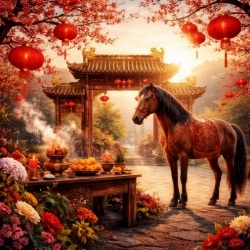
Each year, the Lunar New Year arrives quietly before it arrives loudly.
Firecrackers, parades, red envelopes, and family meals may capture the eye, but from a Taoist perspective, the deeper significance of the Lunar New Year unfolds long before the first celebration begins. It begins in the subtle shift of time itself — in the turning of cycles, the recalibration of qi, and the invitation to begin again without force.
In 2026, the Lunar New Year begins on February 17, opening the Year of the Horse. While popular astrology often emphasizes prediction and personality, Taoism approaches the new year differently. Rather than asking what will happen, Taoist practice asks how to align — how to step into the new cycle with clarity, balance, and minimal resistance.
This article explores how Taoists traditionally and practically approach the Lunar New Year, what makes the transition spiritually meaningful, and how modern practitioners can observe the season with depth — whether or not they belong to a temple community.
The Lunar New Year Through a Taoist Lens
Taoism does not frame the Lunar New Year as a single moment, nor as a command to “reinvent yourself.” Instead, it recognizes the new year as part of a continuum of natural rhythms — one more turn of the wheel rather than a sharp break from the past.
In classical Taoist thought, time is cyclical rather than linear. Seasons rise and fall. Yin gives way to yang, and yang returns to yin. The Lunar New Year marks a renewal of yang movement, following the inward, conserving energy of winter.
This is why preparation matters more than spectacle. The Taoist emphasis is not on celebration for its own sake, but on clearing, harmonizing, and re-orienting so that new movement can arise naturally.
In this sense, the Lunar New Year is less about optimism and more about readiness.
Clearing Before Beginning: Why Letting Go Comes First
One of the most consistent Taoist themes surrounding the new year is release.
Before new energy can flow, stagnation must be addressed. This is why traditional households clean thoroughly in the days leading up to the Lunar New Year — not merely as custom, but as energetic hygiene.
From a Taoist perspective, clutter is not neutral. Physical disorder mirrors energetic congestion. Old resentments, unresolved emotions, and unexamined habits behave the same way: they occupy space that could otherwise support vitality.
Clearing does not require dramatic gestures. Taoist practice favors small, deliberate actions:
Tidying living spaces with awareness
Completing unfinished tasks where possible
Acknowledging emotional patterns without judgment
Letting go of obligations that no longer serve harmony
What matters is intention, not perfection. Clearing is an act of cooperation with the Tao, not a demand for control.
Honoring Lineage and Continuity
Ancestor reverence is often misunderstood as purely cultural, but in Taoism it serves a deeper function. To acknowledge those who came before is to recognize that one’s life is not isolated — it is part of a flowing current.
During the Lunar New Year, Taoists may honor ancestors through simple offerings, quiet remembrance, or spoken gratitude. These gestures are not about nostalgia. They reinforce continuity, reminding the practitioner that life unfolds through relationships across time.
Even for those without a formal altar or inherited ritual structure, this principle can be honored simply:
Reflecting on teachers, family members, or influences who shaped one’s path
Offering thanks inwardly or aloud
Carrying forward what was beneficial, and releasing what was harmful
In Taoism, honoring the past does not bind one to it. Instead, it allows the past to settle, so the present can move freely.
The Year of the Horse (2026): Movement Without Force
The Horse is traditionally associated with movement, vitality, and independence. In Taoist symbolism, however, these qualities are not celebrated unconditionally. Movement without balance can become restlessness. Strength without alignment becomes strain.
The Taoist response to the Horse year is therefore not “go faster,” but move correctly.
This is a year that favors:
Forward motion that is purposeful rather than reactive
Independence grounded in responsibility
Action that arises from clarity, not compulsion
Taoism cautions against forcing outcomes, especially during periods of increased momentum. The Horse reminds practitioners that power is most sustainable when guided, not driven.
Simple Taoist Practices for the Lunar New Year
Taoist practice does not require elaborate ceremony. What it requires is presence.
Here are several grounded ways practitioners may observe the new year:
Quiet Intention Setting
Rather than resolutions, Taoists favor direction. One or two guiding intentions — stated simply and honestly — are more effective than lists of self-demands.
Breath and Stillness
Short periods of quiet breathing or seated stillness help settle the nervous system and attune awareness to subtle change.
Offerings of Appreciation
Offerings need not be formal. A bowl of fruit, incense, or even a moment of gratitude can serve as an acknowledgment of life’s support.
Aligning Daily Rhythm
The new year is an opportunity to adjust sleep, nourishment, movement, and work patterns so they align more closely with natural energy rather than social pressure.
These practices emphasize integration, not performance.
Cultural Celebration and Taoist Meaning
Across East and Southeast Asia — and within diaspora communities worldwide — the Lunar New Year is celebrated in many forms. Parades, temple fairs, family gatherings, and public festivals all carry layers of meaning that blend Taoist, Buddhist, Confucian, and folk traditions.
Taoism does not insist on exclusivity. It recognizes that shared cultural practices often carry multiple truths simultaneously. What matters is whether participation supports balance, connection, and vitality.
One may attend a parade, share a meal, or enjoy fireworks while still observing the Taoist principle of moderation. Celebration and cultivation are not opposites — they simply require awareness.
A New Year Without Strain
Perhaps the most Taoist approach to the Lunar New Year is to resist the urge to over-define it.
There is no requirement to feel inspired. No mandate to transform instantly. No obligation to perform happiness.
The Tao moves regardless of our approval. The role of the practitioner is not to command change, but to remain available to it.
In this way, the Lunar New Year becomes less about what we plan to do, and more about what we allow to emerge when obstruction is reduced.
Carrying the Spirit of the New Year Forward
The true measure of the Lunar New Year is not found in a single day, but in the weeks that follow.
Do habits soften?
Does attention become steadier?
Does life feel slightly less resistant?
These subtle shifts signal alignment far more reliably than dramatic declarations.
For Taoists, the new year is not a beginning imposed from outside. It is a continuation made conscious — a reminder that renewal is always available when we stop pushing against the current.
As the Year of the Horse begins, the invitation is simple:
Move forward, but do not rush.
Act, but do not force.
Begin again, without forgetting what has already carried you this far.
Discover the Path to Real Taoist Practice
Are you exploring Taoist philosophy but unsure how to apply it in your life?
“Journey to the Tao: The First 33.5 Days” bridges the gap between reading the Tao Te Ching and living its wisdom. This course offers proven 1,500-year-old practices to help you:
- Master the principles of Te (spiritual power).
- Eliminate self-sabotage and align with your true nature.
- Build habits that enhance your spiritual and personal success.
Whether you’re new to Taoism or a seasoned seeker, this is your chance to make the Tao a living, daily experience.
Frequently Asked Questions About the Taoist Lunar New Year
What does the Lunar New Year mean in Taoism?
In Taoism, the Lunar New Year marks a renewal of natural cycles rather than a fixed beginning. It reflects the gradual return of outward, active energy after winter and serves as a time to clear stagnation, restore balance, and align with the natural flow of life.
Do Taoists celebrate the Lunar New Year differently?
Taoist observance tends to emphasize preparation and alignment over spectacle. Practices often focus on clearing living spaces, honoring continuity with the past, setting quiet intentions, and supporting harmony rather than making dramatic resolutions.
Is the Lunar New Year a religious holiday in Taoism?
The Lunar New Year is both cultural and spiritual. In Taoism, it is not treated as a doctrinal requirement but as a meaningful moment within a larger rhythm of seasonal and energetic change that supports cultivation and reflection.
What is the Taoist approach to intentions for the new year?
Taoism favors simple direction over rigid goals. Rather than setting strict resolutions, practitioners may hold one or two guiding intentions that support balance, clarity, and responsiveness to changing conditions.
How are ancestors honored during the Lunar New Year in Taoism?
Ancestor honoring in Taoism emphasizes continuity rather than obligation. It may include quiet remembrance, simple offerings, or expressions of gratitude that acknowledge the influence of those who came before without clinging to the past.
What does the Year of the Horse represent from a Taoist perspective?
The Horse is associated with movement and vitality, but Taoism emphasizes movement guided by balance. The Year of the Horse encourages forward motion that arises from clarity rather than force or restlessness.
Do Taoist practices require a formal altar for the Lunar New Year?
Formal altars are not required. Taoist practice values sincerity and awareness over structure. A simple moment of stillness, gratitude, or intentional adjustment to daily rhythms can serve as meaningful observance.
How long does the Lunar New Year period last in Taoist practice?
Taoism views the new year as a gradual transition rather than a single day. The effects of renewal unfold over weeks as habits soften, attention steadies, and alignment becomes more evident in daily life.