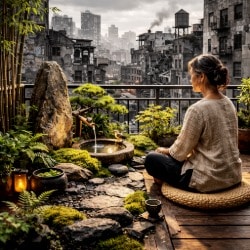
Introduction
A garden does not need acreage.
It needs intention.
In classical Chinese design, vast imperial gardens existed — but so did scholar courtyards no larger than a room. In both cases, the aim was the same: to create a place where the human spirit could realign with the natural order.
A Taoist meditation garden in a small space is not a reduced version of something grander. It is a distilled version. Compression clarifies what matters.
Even a balcony.
Even a corner of a yard.
Even six square feet.
The Tao does not measure in square footage.
It measures in alignment.
Step One: Define the Boundary
A Taoist garden begins with containment.
In large classical gardens, walls framed the world. In a small space, the boundary may be a railing, a fence, a low row of stones, or even a shift in flooring texture.
The boundary does not imprison. It concentrates.
Without a defined edge, the space remains accidental. With a boundary, it becomes intentional.
If you are working with:
A balcony: use large planters to mark a perimeter.
A patio: create a clear rectangle with gravel or stepping stones.
A yard corner: install a subtle border of rock or wood.
The goal is not enclosure for secrecy. It is enclosure for focus.
Inside the boundary, the world changes tempo.
Step Two: Establish Stillness Before Decoration
Many small gardens fail because they are filled too quickly.
In Taoist aesthetics, emptiness precedes form.
Begin with one surface element only:
Raked gravel
Flat stone
Simple grass
Wooden deck boards
Stand within the space before adding anything else.
Does it feel quiet?
Does it feel proportionate?
Can you breathe more slowly here?
If not, reduce before adding.
In small gardens especially, restraint is not optional. It is structural.
Step Three: Introduce One Vertical Element
In classical Taoist gardens, mountains symbolize stability and ascent. Water symbolizes flow. Plants symbolize vitality. But in small spaces, too many symbols compete.
Choose one vertical anchor.
This might be:
A single upright stone
A narrow pine or juniper
A bamboo cluster in a planter
A sculptural wooden post
A lantern form (stone or wood)
The vertical element functions as the “mountain” of the space.
It provides orientation.
Position it slightly off center — never dead center. Classical Chinese design favored asymmetry because nature rarely balances itself mechanically.
Stand again. Notice the shift.
The garden now has a spine.
Step Four: Add a Horizontal Counterpoint
Where there is vertical rise, there must be grounding.
This could be:
A flat meditation stone
A low bench
A shallow bowl of water
A ground-cover plant spreading outward
In Taoist cosmology, balance is not achieved through equality. It is achieved through relationship.
Vertical without horizontal feels tense.
Horizontal without vertical feels stagnant.
In a small space, two strong elements are often enough.
Everything else should whisper.
Step Five: Use Plants with Character, Not Volume
Avoid the instinct to “green” the space heavily.
Taoist garden design favors plants that express time and endurance:
Pine (longevity)
Bamboo (resilience)
Plum blossom (renewal)
Moss (quiet age)
Ferns (soft continuity)
In small urban gardens, practical substitutes are acceptable. Dwarf evergreens, hardy ornamental grasses, or slow-growing shrubs work well.
The key question is not: “Is this lush?”
The question is: “Does this plant feel composed?”
If a plant spills chaotically, it disrupts meditation. Choose specimens that grow with intention.
Step Six: Introduce Water — or Suggest It
Water is central to Taoist imagery, but small spaces cannot always hold ponds.
Alternatives:
A shallow ceramic basin
A small recirculating fountain
A bowl that reflects the sky
Even a smooth river stone that implies water’s shaping force
The sound of subtle water can transform a city balcony into a refuge.
If sound is not possible, reflection is enough.
Taoist gardens often rely on suggestion. A curved line of stones can imply a stream. A patch of raked gravel can evoke a dry riverbed.
Suggestion engages the mind. Excess overwhelms it.
Step Seven: Create a Meditation Position
Without a designated place to sit or stand, the garden becomes decorative.
Choose:
A low wooden bench
A flat stone seat
A simple meditation cushion
Position it so that your gaze rests on the vertical element, but not in a confrontational line. Slight angle is better.
The meditation seat should feel like a natural pause in the landscape, not furniture placed after the fact.
When seated, nothing should feel crowded.
If it does, remove something.
The Principle of Compression
A small Taoist meditation garden operates under a single governing rule:
Every element must justify its presence.
Large gardens can afford wandering paths and hidden corners. Small gardens cannot. Every stone, plant, and line must participate in harmony.
This discipline mirrors Taoist internal cultivation.
Just as excessive thought clouds clarity, excessive ornament clouds space.
Remove until the space breathes.
Then stop.
Light and Shadow
In classical gardens, shifting light was considered part of the design.
Observe your small space at:
Morning
Midday
Late afternoon
Night
Notice where shadows fall.
If possible, allow dappled light rather than harsh exposure. A simple bamboo screen or climbing vine can soften glare.
Meditation deepens when the eyes are not strained.
At night, avoid bright artificial lighting. A single lantern glow is sufficient.
In Taoist thought, subtlety is strength.
Sound Management
Urban gardens must contend with noise.
While total silence may not be possible, small interventions help:
Water trickle
Wind chime of natural material (bamboo or stone, not metallic harshness)
Dense foliage that absorbs echo
The goal is not to overpower city sound. It is to create a counterpoint.
Even in classical Chinese cities, gardens existed amid noise. The sanctuary was psychological as much as physical.
Symbol Without Clutter
Many modern interpretations overload small meditation spaces with overt symbolism: dragons, multiple statues, calligraphy plaques.
In Taoist tradition, symbolism was often subtle.
One stone can represent a mountain.
One bowl of water can represent a lake.
One pine branch can suggest endurance.
Trust suggestion.
Overt declaration diminishes contemplation.
Seasonal Awareness
A Taoist meditation garden is not static.
In spring, new growth draws the eye upward.
In summer, shade matters most.
In autumn, fallen leaves create natural composition.
In winter, bare structure reveals line and proportion.
Even in a small balcony garden, allow season to remain visible.
Do not attempt to freeze the space in perpetual summer.
Time is part of the design.
Maintenance as Practice
A Taoist meditation garden requires care.
Raking gravel.
Trimming branches.
Wiping stone.
Refreshing water.
These are not chores.
They are extensions of meditation.
In classical scholar gardens, maintenance was itself a contemplative act. Order restored externally encourages clarity internally.
In a small space, even five minutes of attention per day is enough.
Common Mistakes in Small Taoist Gardens
The most frequent errors are predictable.
Too many elements.
Too much color contrast.
Excess ornament.
Ignoring proportion.
Neglecting the meditation seat.
Small spaces magnify imbalance.
When in doubt, remove.
Why Small Gardens Often Feel More Powerful
Large gardens inspire awe.
Small gardens invite stillness.
In limited space, the mind cannot wander far physically. It turns inward more quickly. This is one reason scholar gardens — often modest in scale — were used for poetry, calligraphy, and meditation.
A small Taoist meditation garden, when designed carefully, becomes a vessel.
A container for breath.
A frame for reflection.
A pause in the ordinary day.
And perhaps that is the most Taoist quality of all.
The Tao does not require magnitude.
It requires attention.
Frequently Asked Questions
What makes a garden “Taoist,” instead of just a small meditation garden?
How small can a Taoist meditation garden be and still work?
Do I need a water feature for it to “count”?
What are the best plants for a small Taoist meditation garden?
How do I keep it from looking “too Zen”?
I’m renting. What small-space Taoist garden elements are renter-safe?
How do I handle wind, heat, or harsh sun on a balcony?
What’s the simplest layout that still feels authentic?
Can I include a statue, incense burner, or altar piece?
How do I make it feel private if I’m surrounded by neighbors?
How much maintenance does a small Taoist meditation garden require?
What if I only have a very low budget?
Further Articles Exploring Taoism and Nature
Trees in Taoism: Sacred Roots, Symbolism, and Practice Across Time and Tradition
Animals in Taoism: Companions, Teachers, and the Tao
Gathering the Elixir: Taoist Alchemy and the Season of Autumn
Winter in Taoism: The Deep Season of Return
Taoism and Weather: History, Rituals, and Meaning Across Cultures
Taoist Gardens: Sacred Spaces of Nature, Stillness, and the Dao
How to Build a Taoist Meditation Garden in a Small Space
How to Create a Taoist Garden: Design Principles and Layout
Peaches of Immortality: Taoism’s Symbol of Longevity and Spiritual Transformation