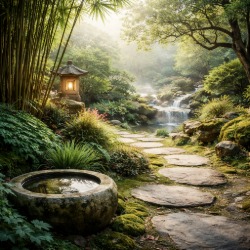
Introduction
A Taoist garden is not built.
It is aligned.
That distinction is the beginning of all proper Taoist garden design.
In many Western traditions, a garden is arranged for display — symmetry, color control, visual dominance. A Taoist garden grows from a different principle. It does not force nature into order. It reveals the order already present.
If you are searching for how to create a Taoist garden, begin here:
You are not designing an object.
You are shaping a relationship between land, season, and awareness.
What Is a Taoist Garden?
A Taoist garden is a landscape shaped around Taoist principles — harmony, natural flow, balance of elements, and deliberate emptiness.
Historically, Taoist influence can be seen in classical Chinese gardens, particularly in regions such as Suzhou during the Ming and Qing dynasties. These gardens were designed to mirror mountains, rivers, clouds, and shifting terrain in miniature. They were not meant to overwhelm the viewer. They were meant to cultivate perception.
The philosopher Zhuangzi wrote often of wandering freely within nature — not conquering it, not improving it, but moving in accordance with it. A Taoist garden embodies this wandering.
It is not a theme.
It is a practice environment.
Step One: Clarify Your Purpose Before Designing
Before creating a Taoist garden layout, determine its function.
Is this garden for:
Meditation?
Seasonal observation?
Walking contemplation?
Quiet tea practice?
Symbolic ritual space?
Your intention determines structure.
A Taoist garden can be:
A full backyard
A courtyard
A narrow side yard
A balcony corner
Even a structured indoor plant arrangement
The Tao does not require scale.
It requires alignment.
Spend several days observing your chosen space. Note:
Sun patterns
Wind direction
Soil moisture
Natural slope
Existing vegetation
Noise levels
Do not design immediately.
Observation precedes action.
Step Two: Work With Climate, Not Against It
One of the most common mistakes beginners make in Taoist garden design is imitation without adaptation.
You do not need bamboo in the desert.
You do not need moss in dry mountain air.
You do not need koi ponds where water evaporates rapidly.
Instead, design a Taoist garden suited to your region.
If you are in:
Arid climates (e.g., Arizona, Nevada):
Use stone prominently
Incorporate drought-tolerant shrubs
Use gravel to suggest flowing water
Emphasize shadow and vertical elements
Temperate climates:
Introduce layered plantings
Include a reflective water basin
Use natural wood pathways
Humid regions:
Allow denser foliage
Use shaded seating
Encourage gradual path reveals
Taoism does not argue with the environment.
It cooperates with it.
This cooperation is the foundation of authentic Taoist garden principles.
Step Three: Introduce the Five Elements Subtly
In Taoist cosmology, the Five Phases (Wood, Fire, Earth, Metal, Water) describe cycles of transformation in nature.
A balanced Taoist garden layout reflects these phases — not through excess decoration, but through suggestion.
Wood: Trees, shrubs, grasses, vertical growth
Fire: Sunlight exposure, lantern light, warmth
Earth: Soil beds, clay pots, stone foundations
Metal: Structural framing, wind chimes, simple tools
Water: Basin, bowl, dark stone grouping, actual pond if climate allows
Balance is not achieved by quantity.
It is achieved by proportion.
A single basin may represent water more effectively than a large fountain.
One lantern may suggest fire more gracefully than bright electric lighting.
Restraint creates harmony.
Step Four: Design for Movement, Not Display
Western gardens are often designed for viewing from one angle — a patio chair, a photograph, a window.
A Taoist garden is meant to be experienced through movement.
Create:
Curved paths instead of straight lines
Partial visual obstructions
Layered reveals
Stepping stone progressions
Even in small spaces, create directional flow.
If your garden is only 10 by 12 feet, consider:
Three stepping stones placed asymmetrically
A shrub that partially blocks the full view
A corner feature that requires walking to see clearly
Movement mirrors cultivation.
As perspective shifts, the mind softens.
This is not decoration.
It is training.
Step Five: Use Emptiness as Structure
In the Daodejing, usefulness comes from emptiness.
The usefulness of a bowl lies in its hollow.
The usefulness of a room lies in its open space.
A Taoist garden must breathe.
Do not fill every corner.
Leave:
Open gravel areas
Negative space between plants
Clear sightlines
If your instinct says something is missing, ask whether what is missing is space.
Emptiness is not absence.
It is function.
Without emptiness, a Taoist garden becomes cluttered ornament.
Step Six: Create Seasonal Awareness
An authentic Taoist garden changes throughout the year.
Design for seasonal transformation.
Consider:
Early spring emergence (bulbs, budding shrubs)
Summer fullness (leaf canopy)
Autumn texture (grasses, seed heads)
Winter structure (bare branches, stone emphasis)
Even desert climates experience seasonal light shifts and temperature transitions.
A Taoist garden is a living calendar.
The seasons become instruction in impermanence and renewal.
Step Seven: Choose Symbol Carefully
Symbol in Taoist gardens is quiet.
One upright stone may suggest mountain stability.
A tortoise figure may suggest longevity.
A small inscribed plaque may invite reflection.
Do not over-symbolize.
The moment symbol becomes dominant, harmony weakens.
Let symbol whisper.
A Simple Beginner Taoist Garden Layout
If you are creating your first Taoist garden, use this minimalist structure:
One curved path or stepping stone sequence
One water representation (basin, bowl, or stone grouping)
Three plant layers:
Ground cover
Mid-height shrub
Vertical accent
One symbolic element
Clear open space
This structure can be implemented in:
100 square feet
500 square feet
Or a small courtyard
Scale does not determine authenticity.
Alignment does.
Common Beginner Mistakes
When learning how to create a Taoist garden, avoid:
Copying East Asian aesthetics without adaptation
Overfilling the space
Ignoring regional ecology
Designing for social media rather than lived experience
A Taoist garden is not a stage set.
It is an environment for cultivation.
If something feels forced, simplify.
Final Reflection
You do not create harmony.
You remove obstruction.
You do not impose order.
You allow relationship.
Stand in the space once it is arranged.
Observe wind.
Notice shadow movement.
If adjustment is needed, make it gently.
A Taoist garden is not finished when the stones are set.
It begins when you stop correcting it.
Where to Go Next
In future articles in this Taoist garden series, we will explore:
Taoist garden plants by climate
Water features and symbolic depth
Small courtyard and balcony Taoist gardens
Taoist garden design for meditation practice
Each builds upon the principles outlined here.
How to Create a Taoist Garden: Step-by-Step Guide
-
Observe Your Space
Spend several days studying light, wind, soil moisture, slope, and existing plant life before making design decisions. -
Define the Garden’s Purpose
Decide whether the garden will serve meditation, seasonal reflection, walking contemplation, or symbolic ritual. -
Work With Your Climate
Choose plants, stones, and water elements suited to your regional ecology rather than copying foreign aesthetics. -
Introduce the Five Elements Subtly
Incorporate Wood, Fire, Earth, Metal, and Water through proportion and suggestion, not excessive decoration. -
Create Curved Movement
Design pathways that guide gentle exploration instead of straight visual lines. -
Leave Intentional Emptiness
Preserve open space to allow visual pause and natural flow. -
Add One Symbolic Element
Include a single stone, basin, lantern, or sculpture to anchor meaning without clutter.
Frequently Asked Questions About Taoist Gardens
What is the difference between a Taoist garden and a Zen garden?
A Taoist garden emphasizes natural flow, movement, and harmony between the Five Elements. Zen gardens tend to focus on minimalism and abstraction rooted in Japanese Buddhist tradition.
Can I create a Taoist garden in a small backyard?
Yes. A Taoist garden can be created in small spaces, including courtyards or balconies, by using curved movement, layered planting, and intentional emptiness.
Do I need a water feature in a Taoist garden?
Water is traditionally important, but it can be represented symbolically with a basin, bowl, or dark stone grouping if climate or space limits installation.
What plants are best for a Taoist garden?
The best plants are those suited to your climate. Native or climate-adapted species create more authentic harmony than imported ornamental varieties.
Is a Taoist garden religious?
A Taoist garden reflects Taoist philosophy but does not require religious practice. It serves as a contemplative landscape aligned with natural principles.
Further Articles Exploring Taoism and Nature
Trees in Taoism: Sacred Roots, Symbolism, and Practice Across Time and Tradition
Animals in Taoism: Companions, Teachers, and the Tao
Gathering the Elixir: Taoist Alchemy and the Season of Autumn
Winter in Taoism: The Deep Season of Return
Taoism and Weather: History, Rituals, and Meaning Across Cultures
Taoist Gardens: Sacred Spaces of Nature, Stillness, and the Dao
How to Build a Taoist Meditation Garden in a Small Space
Peaches of Immortality: Taoism’s Symbol of Longevity and Spiritual Transformation